
If you first want the basics, our guide answers what is workflow automation before any comparison.
Who is writing. Romain Ben, co-founder and AI engineer at OptimizIA.xyz, designs and maintains the workflows described on this page. He works with Rémy Ginoux, co-founder, who brings 25 years of industrial and digital transformation at Volvo Group, Airbus Atlantic and Solvay. We are an agency, so weigh the verdict below accordingly: the criteria and the table are there so you can check it against your own situation.
The verdict: two paths, one clear winner for most SMEs
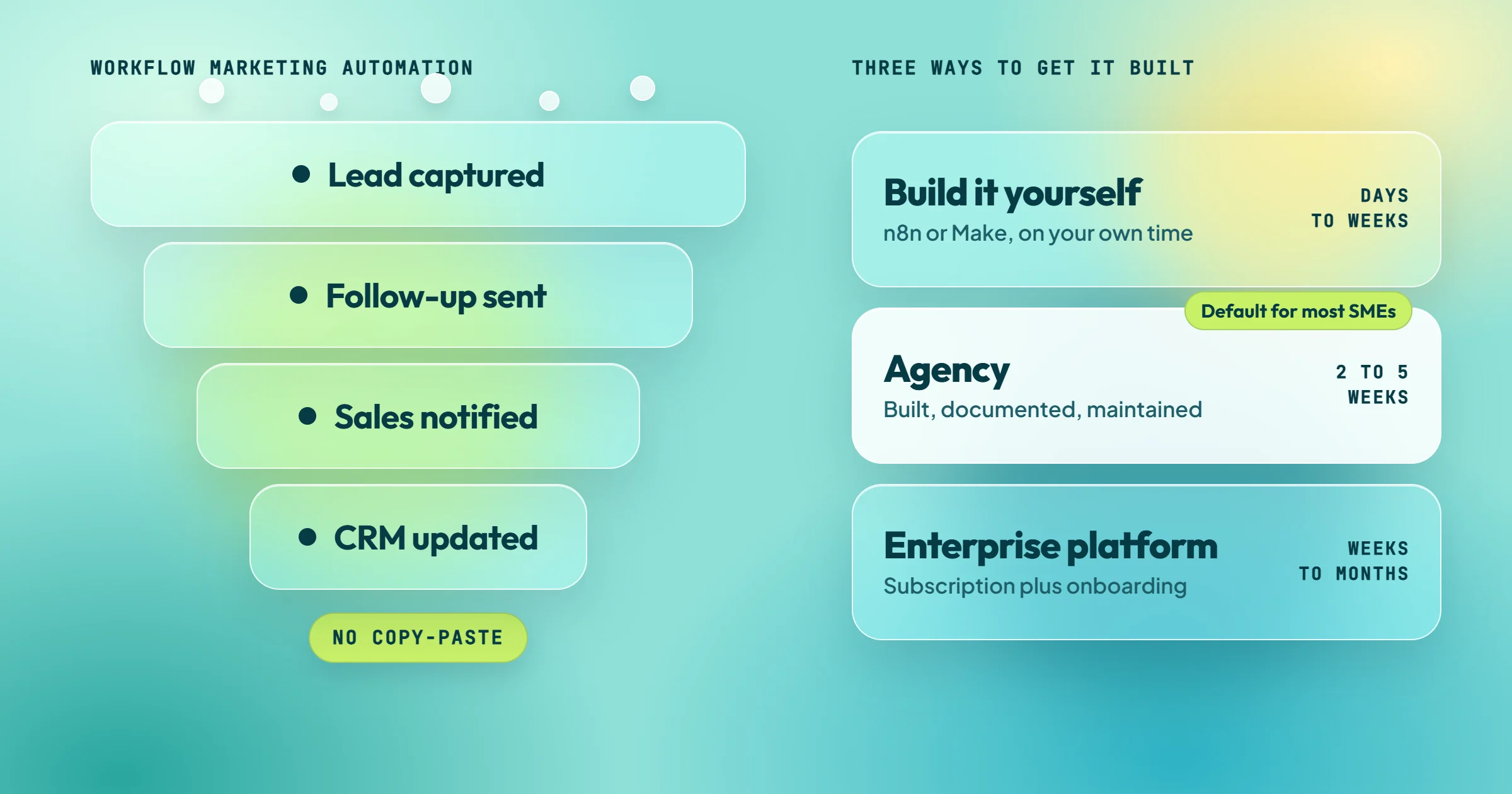
There are two realistic ways to implement workflow marketing automation in a small or medium business:
- Build it yourself with a no-code tool. The self-build path works if you have someone on your team who enjoys tinkering with tools and has a few hours per week to spare.
- Hire an agency to build and maintain it for you. The agency path works if you want the workflow live within weeks and you do not want to become the automation expert.
For most SMEs, the agency path is the better default. Here is why: a marketing automation workflow touches your CRM, your email platform, your forms, and often your internal communication tools. Each of these has its own quirks. An agency that has built dozens of these workflows knows where the common failure points are. They also know how to document the workflow so that a new employee can understand it. If you build it yourself, you will spend your first weeks learning the tool, not improving your marketing.
That said, the self-build path is not wrong. If your marketing stack is simple, say a form, a spreadsheet, and an email tool, you can get a basic workflow running in an afternoon with n8n or Make. The problems start when you want to add conditional logic, error handling, or integrations with tools that do not have native connectors. At that point, the time cost of self-building often exceeds the cost of hiring an agency.
If you take the self-build path, our comparison of no code workflow automation platforms helps you choose between n8n, Make and Zapier.
Selection criteria: what actually matters for SME workflow automation
When comparing workflow marketing automation options, most comparison articles focus on feature lists. Features matter, but they are not the first thing to check.
Time to first value
For an SME, the first criterion is time to first value. How long until the workflow is doing something useful? A tool with a hundred integrations but a steep learning curve will delay your first win. A simpler tool that connects to your existing stack will deliver value faster.
Maintenance burden
The second criterion is maintenance burden. Every workflow needs upkeep. APIs change, tools update their interfaces, and your business processes evolve. If you build the workflow yourself, you are the maintenance team. If you hire an agency, they can handle updates as part of a copiloting agreement. Ask yourself: do you want to spend Friday afternoons debugging a webhook?
Total cost
The third criterion is total cost, not just the tool subscription. A no-code tool may cost a few dozen euros per month, but your time is not free. An agency may charge a few thousand euros upfront, but that includes design, implementation, documentation, and training. For a fair comparison, estimate the hours you would spend learning, building, and maintaining, and multiply by your hourly rate.
Handover quality
A fourth criterion, often overlooked, is handover quality. If the person who built the workflow leaves your company, can someone else take over? An agency should provide documentation and a handover session. If you build it yourself, you need to write that documentation. Most people skip this step, and the workflow becomes a black box that nobody dares to touch.
Comparison table: self-build vs agency vs enterprise platform
| Option | Time to first value | Maintenance burden | Upfront cost | Best for |
|---|---|---|---|---|
| Self-build with n8n or Make | Days to weeks, depending on skill | High: you own all updates and fixes | Low: tool subscription only | Teams with technical skill and simple stacks |
| Agency build (our own figures) | 2 to 5 weeks; PoC to MVP in 13 days on average | Low: the agency can copilot and maintain | Medium: fixed fee from €1,500 excl. VAT for a PoC or MVP | SMEs that want results without becoming automation experts |
| Enterprise platform (e.g., HubSpot's upper tiers, Marketo) | Weeks to months: setup and onboarding | Medium: platform updates, but you manage workflows | High: subscription plus onboarding fees | Larger companies with dedicated marketing ops |
This table is a simplification, but it reflects the real trade-offs. The enterprise platforms are powerful, but they are overkill for most businesses without a dedicated marketing operations person. Their pricing models often scale with contacts, which punishes you for growing your list. The self-build tools are flexible, but they require a mindset of continuous learning. The agency path sits in the middle: you pay for expertise, but you get a workflow that is tailored to your processes and documented for your team.
Who should choose which option?
Choose self-build if
- You have a technical person on your team who is curious about automation.
- Your marketing stack is limited to two or three tools.
- You have a clear, simple workflow in mind.
A good starting point is a lead notification workflow: when a form is submitted, send a message to a Slack channel and add the lead to a Google Sheet. You can build that in an afternoon with Make.
Choose an agency if
- You have multiple lead sources.
- You need conditional routing based on lead score or behavior.
- You want to integrate with a CRM that has no native connector.
- You simply do not want to spend your time on technical details.
An agency can also help you identify which workflows will have the highest ROI, rather than automating everything at once. For example, our AI & Knowledge Diagnostic maps your processes and identifies automation opportunities before any build starts.
Choose an enterprise platform if
- You have a dedicated marketing operations person.
- You have a budget of at least several hundred euros per month, often several thousand.
- You need advanced features like predictive lead scoring or multi-touch attribution.
For most SMEs, this is not the case.
A common mistake is to start with the tool and then look for a problem to solve. The better approach is to start with a specific, painful process, then choose the tool or partner that can fix it fastest. If you are not sure which process to automate first, a diagnostic can help. Ours starts at €1,000 excl. VAT, takes one to three weeks, and ranks the priority use cases with an estimate of the gain. It is a recommended entry point, not a required one: if you already know which workflow you need, you can go straight to a proof of concept.
What it looks like in practice: two workflows we run
Our own newsletter
The form in the footer of this site is a marketing workflow. When someone subscribes, a workflow adds the contact to our email platform, logs the subscription and sends a welcome email. Every Thursday at 8:00, a second workflow reads about thirty news sources, selects nine articles, writes the issue and sends it, with no proofreading step. The first scheduled issue went out on October 8, 2026, in under two minutes. Both run on n8n, with Brevo as the email platform.
What makes an unreviewed send acceptable is the design, not the AI model. The model never writes a link: it only returns article identifiers, and the code places the URLs it collected, so an invented link is impossible by construction. An issue that fails validation does not go out. It raises an alert instead.
Lead monitoring for a client
For an influence agent, we built a lead monitoring system that reads the trade press of his sector every weekday morning, ranks each signal in three tiers and emails a written report. It is prospecting rather than email marketing, but the anatomy is the same: a trigger, a few sources, rules for what matters, and a human who only sees what is worth acting on.
Neither took an enterprise platform. Both took the time to write down the rules before building, which is the part no tool does for you.
Price ranges: what drives the cost of workflow marketing automation
Pricing for workflow marketing automation varies widely, but the main cost drivers are the same across options:
- Complexity of the workflow. A simple linear workflow with one trigger and two actions is cheap to build. A workflow with multiple branches, error handling, and custom API calls takes more time.
- Number of integrations. Each tool you connect adds setup and testing time.
- Documentation and training. If you want a handover document and a training session for your team, that adds to the cost.
Self-build
For self-build, the only direct cost is the tool subscription. n8n offers a free self-hosted version, and Make has a free plan limited to 1,000 credits per month. Paid plans start at around $9 per month on Make and €20 per month on n8n Cloud. But remember to factor in your time. If you spend 20 hours learning and building, and your hourly rate is €50, that is €1,000 of hidden cost.
Agency build
For an agency build, you can expect a fixed price based on the scope. Our PoC and MVP service starts at €1,500 excl. VAT, and our copiloting service starts at €100 excl. VAT per month. These are starting prices, and the final quote depends on the complexity of your workflow. The advantage of a fixed price is that you know the cost upfront, and there are no surprises. Both are published on our services page.
Enterprise platform
Enterprise platforms typically charge a monthly subscription based on the number of contacts, plus an onboarding fee. The subscription can range from a few hundred to several thousand euros per month. HubSpot is a useful benchmark: its workflow tool starts with the Professional tier of Marketing Hub, from $800 per month with a required $3,000 onboarding, and the Enterprise tier starts at $3,600 per month with a $7,000 onboarding. For an SME, this is rarely justified.
Common questions during the selection process
How long does it take to implement a workflow marketing automation?
If you build it yourself with a no-code tool, a simple workflow can be live in a day. A more complex workflow with multiple integrations might take a week or two of part-time work. If you hire an agency, the timeline depends on their process. On our projects, a PoC or MVP takes two to five weeks, and going from PoC to a functional MVP takes 13 days on average. That covers scoping, the build on a controlled scope and a user onboarding guide.
What if the workflow breaks after launch?
Workflows break for many reasons: an API changes, a tool updates its interface, or a rate limit is hit. If you built it yourself, you need to diagnose and fix the issue. If you have an agency on a copiloting agreement, they handle updates and fixes as part of the service. This is a key reason to consider a maintenance plan, even if you build the initial workflow yourself.
Can I start with one workflow and expand later?
Yes, and this is the recommended approach. Start with a single, high-impact workflow, measure the results, and then expand. This reduces risk and helps you learn what works for your business. An agency can help you prioritize which workflows to build next based on their diagnostic.
Frequently asked questions
What is workflow marketing automation?
Workflow marketing automation is the use of software to connect marketing tools and automate repetitive tasks, such as lead capture, follow-up emails, and reporting. It replaces manual work with rule-based processes that run automatically.
Do I need to know how to code to use workflow marketing automation?
No. No-code tools like n8n and Make allow you to build workflows with a visual interface. However, some technical understanding helps when troubleshooting. If you prefer not to deal with the technical side, you can hire an agency to build and maintain the workflows for you.
How much does workflow marketing automation cost for an SME?
It depends on the approach. Self-building with a no-code tool costs only the tool subscription, typically under €50 per month, plus your time. Hiring an agency costs more upfront, with fixed prices starting around €1,500 excl. VAT for a PoC or MVP, but includes expertise and documentation. Enterprise platforms are the most expensive, from several hundred to several thousand euros per month.
What is the first workflow I should automate?
For most SMEs, the first workflow should be lead follow-up. When a lead submits a form, automatically send a personalized email, notify the sales team, and add the lead to your CRM. This workflow has a direct impact on revenue and is relatively simple to build.
Can workflow marketing automation work with my existing tools?
In most cases, yes. No-code tools offer integrations with thousands of popular apps. If a native integration is missing, you can often use webhooks or APIs to connect tools. An agency can assess your stack and recommend the best approach.