
If you are still deciding whether intelligent automation is worth it for your business, start with our framework for SMEs. This page looks at the choice from the other end: what an enterprise platform such as IBM's covers, the customer care pattern it automates, and how much of it an SME can rebuild with lighter tools.
What IBM Intelligent Automation Covers
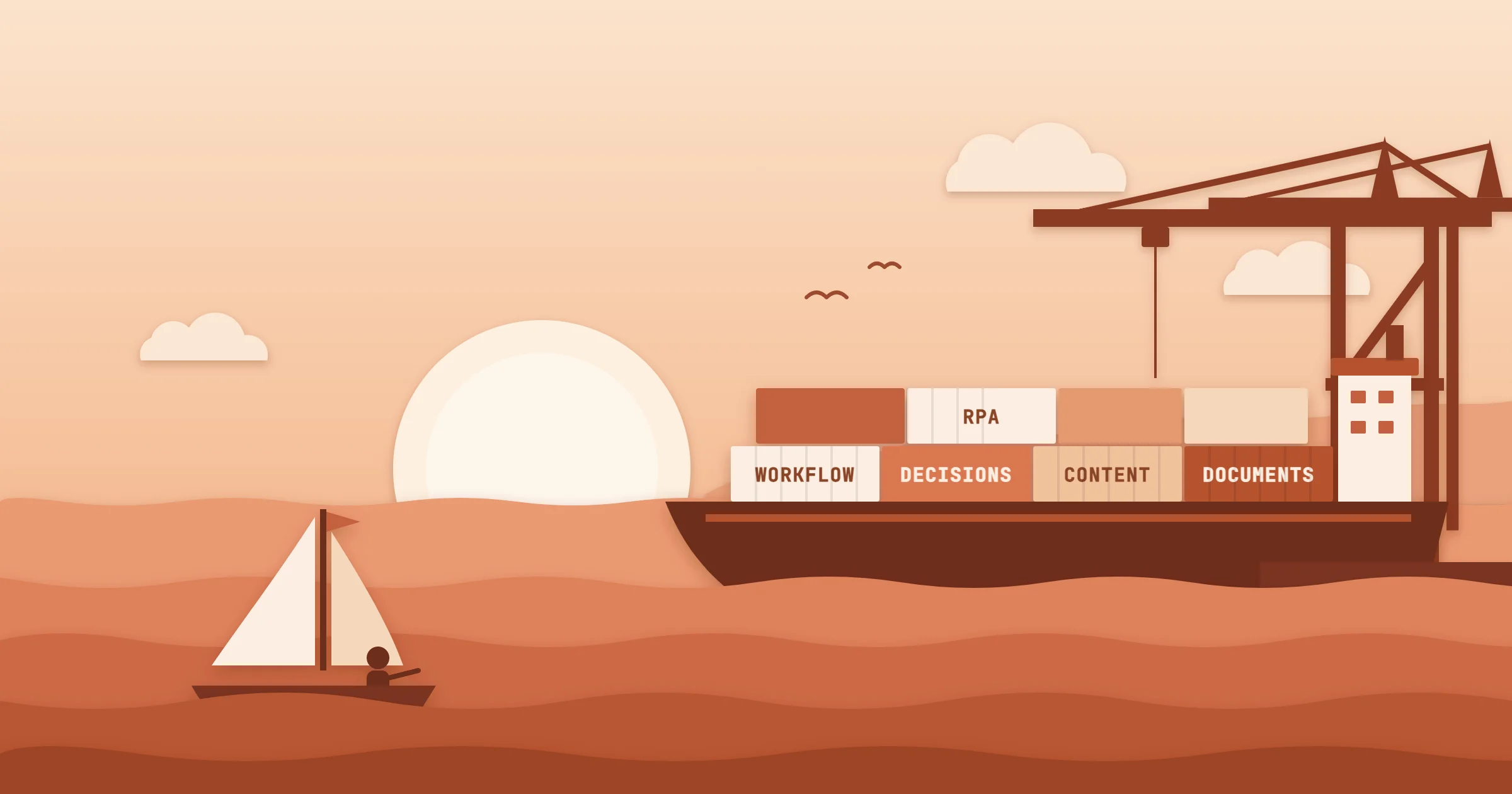
IBM sells intelligent automation as a platform: Cloud Pak for Business Automation brings together workflow, decision rules, content management, document processing and robotic process automation, and watsonx Orchestrate adds AI agents, customer service included. Each deployment is run for one organization, usually by a dedicated team or an IBM partner.
A customer care deployment on that kind of platform is used by teams that manage customer interactions, automate routine service tasks, and route complex cases to human agents. It combines several layers: a workflow engine, a knowledge base, and an AI layer that interprets requests.
For an SME, the relevant question is not whether such a platform works. It does, in large deployments with dedicated infrastructure. The question is whether your business needs that level of complexity. Most SMEs do not. They need a workflow that moves a customer request from intake to resolution without manual copying, and a knowledge base that gives the right answer without searching through folders.
That is where OptimizIA.xyz comes in. We build automation on n8n and Make: n8n hosted on your infrastructure or on our servers located in France, Make in its own cloud. We do not lock you into an enterprise platform. We hand over the workflows and the documentation.
If Your Company Already Runs IBM
If your organization already runs an IBM environment, access and support go through your IBM administrator or the partner that manages your license: OptimizIA.xyz does not implement or resell IBM products. What we can do is help with the workflows around it, on tools your team can maintain.
The Five Steps Behind Customer Care Automation
The platform handles customer care, but the underlying logic applies to many SME workflows: intake, classification, retrieval, action, handoff. Each step exists on both sides; only the tooling changes.
| Step | What it does | On an enterprise platform | On a lighter stack |
|---|---|---|---|
| Intake | Collects the request from email, a form or a chat | Channel connectors and a virtual agent | An n8n or Make trigger on the mailbox, form or chat |
| Classification | Decides what the request is about and how urgent it is | Intent recognition and decision rules | One narrow call to a language model, with a fixed list of categories |
| Retrieval | Finds the answer in the company's documents | Content management and knowledge base | RAG: a search index over your own files, answers that cite their source |
| Action | Drafts the reply, updates the CRM, opens a ticket | Workflow engine and RPA bots | Workflow steps and API calls; a screen robot only when the software has no API |
| Handoff | Passes complex or uncertain cases to a person | Routing to human agents | A message to the right person, with the context attached |
The lighter column is not a downgrade of the first. Each step stays narrow, so it can be tested on its own and replaced without rebuilding the rest. Our guide to intelligent process automation shows how to design the classification step with a fallback for low-confidence cases, and our page on intelligent robotic process automation covers the rare case where a screen robot is needed.
What RAG Adds, and What It Does Not
RAG, for retrieval-augmented generation, means the model answers from passages retrieved in your own documents rather than from memory. It is what turns a folder of procedures into an assistant that answers a customer question and shows where the answer comes from. It does not fix a knowledge base that is out of date: if two procedures contradict each other, the assistant will quote both. That is why our diagnostic looks at the documents before the tools.
Replicate, Simplify or Skip
Seeing an enterprise platform at work is useful even if you never buy one. For an SME, it gives:
- A reference model for SME automation. An enterprise platform shows what intelligent automation looks like at scale. You can use that model to decide what to replicate and what to skip.
- A clear comparison point. Seeing an enterprise platform helps you understand why a lighter stack often delivers faster results for a smaller team.
- A starting point for a diagnostic. If you are evaluating automation options, the five steps above give you a concrete benchmark to discuss with a consultant.
- A list of what not to carry over. Dedicated infrastructure, licenses sized for thousands of users and a team to administer them are overhead for a company of thirty people.
| Criterion | Enterprise platform | Lighter stack (n8n, Make) |
|---|---|---|
| Pricing | Licenses on quote, sized for large volumes | n8n free self-hosted or cloud from €20/month, Make from $9/month, plus AI usage |
| Who runs it | A dedicated team, often with an integration partner | One owner in the business, with copiloting if needed |
| Hosting | The vendor's cloud or your own data center | n8n on your server or on servers in France, Make in its cloud |
| Best for | Large organizations with high volumes and strict governance | SMEs up to 250 employees, one workflow at a time |
OptimizIA.xyz can run a diagnostic on your current processes and tell you which parts of that logic make sense for your size, and which parts are overhead you can avoid. Our guide to enterprise workflow automation compares five paths for SMEs, and our shortlist of AI powered workflow automation platforms covers UiPath and Power Automate, the enterprise tools an SME meets most often.
What You Get From OptimizIA.xyz
If you are an SME and you want to apply this logic without the enterprise weight, OptimizIA.xyz offers three service levels, with prices published on our services page.
- AI & Knowledge Diagnostic, from €1,000 excl. VAT. One to three weeks. We review your current workflows, your knowledge base, and your automation opportunities. You get a written assessment and a shortlist of actions.
- PoC and MVP, from €1,500 excl. VAT. We build a working automation on n8n or Make, connected to your data, with a RAG layer over your business documents if needed. You test it on real cases, and a validated PoC becomes an MVP in 13 days on average.
- Copiloting and continuous improvement, from €100 excl. VAT per month. We monitor the automations, adjust them as your processes change, and train your team to maintain them.
Software subscriptions and AI usage usually add a few tens of euros a month for an SME workload. We also run AI training workshops for teams who want to understand the tools they use. We do not sell sales or customer service bots as generic products. We build what your diagnostic shows you need, and we document everything.
Will a Lighter Stack Be Reliable Enough?
The main objection we hear from SMEs is: “Enterprise platforms are too heavy for us, but we are afraid a lighter tool will not be reliable.” That fear is reasonable. The answer is not to promise enterprise reliability with a small budget. The answer is to be precise about what you automate and what you leave manual.
Rémy Ginoux, co-founder of OptimizIA.xyz, spent more than 25 years in industrial and digital transformation at Volvo Group, Airbus Atlantic and Solvay before focusing on SMEs, and has seen automation fail when it tried to cover too much. The OptimizIA.xyz approach is to start with one workflow, measure the time saved and the error rate, and expand only when the first loop is stable.
We run our own production on that light stack. A lead monitoring pipeline on n8n reads a whole sector's trade press for a client every weekday morning, scores what it finds and delivers a sorted table. Our weekly newsletter is written and sent by an n8n workflow with no proofreading step, because the code, not the model, places every link; our article on workflow marketing automation describes that chain. Neither needs an enterprise license or a team to administer it.
We host on your infrastructure or on servers located in France. You keep control of your data. We hand over the workflows and the documentation, so you are not dependent on us. If your team cannot maintain a workflow, we tell you not to build it. That is a limit we accept.
Take the Next Step
If your organization already runs IBM, keep it for what it does well. If you want to evaluate whether the same automation logic fits your SME, contact OptimizIA.xyz for a diagnostic, or check first with our automation ROI calculator whether the numbers work.
The diagnostic is the first step. It gives you a clear picture of what to automate, what to leave alone, and what it will cost. No vague roadmap. No enterprise sales cycle.
Frequently asked questions
Is IBM intelligent automation suited to an SME?
Rarely. It is built for large organizations with high volumes, strict governance and a team to run it, and its licenses are sold on quote. An SME usually gets the same customer care pattern with n8n or Make, one narrow AI step and RAG over its own documents, for a few tens of euros a month in subscriptions, plus the build.
Can OptimizIA.xyz help me implement IBM's automation platform?
No. OptimizIA.xyz does not implement or resell IBM products. We help SMEs build automation with n8n, Make, and RAG over their own data. If you need support on an IBM deployment, contact IBM or an IBM partner.
Is a lighter automation stack really enough for my business?
For most SMEs up to 250 employees, yes. The key is to automate one workflow at a time, measure the result, and expand only when the first loop is stable. A diagnostic helps you decide where to start.
How much does an OptimizIA.xyz diagnostic cost?
The AI & Knowledge Diagnostic starts from €1,000 excl. VAT and takes one to three weeks. It includes a review of your current workflows, your knowledge base, and a written shortlist of automation actions.